
Online Safety & Protecting Children
Could Online Gaming Be an Overlooked Tool for Helping Children Connect?
Concerns about children's online gaming are understandable. Bullying, inappropriate communication, excessive screen time and exposure to strangers are genuine risks.
But does that mean online gaming itself should be avoided, or should we look more closely at the environment in which children participate?
Published Updated
Why Are Professionals Concerned About Online Gaming?
Psychologists, educators and parents have good reasons to question whether online gaming is appropriate for children.
Unrestricted multiplayer games can expose young people to aggressive behaviour, exclusion, inappropriate language and unwanted contact.
For children experiencing anxiety, social difficulties or challenges interpreting social situations, these environments may be particularly difficult to navigate.
Excessive gaming can also interfere with sleep, education and other important activities.
These concerns should not be dismissed. In fact, they should inform how safer and more supportive gaming environments are designed.
What Can a Football Match Teach Us About Online Gaming?
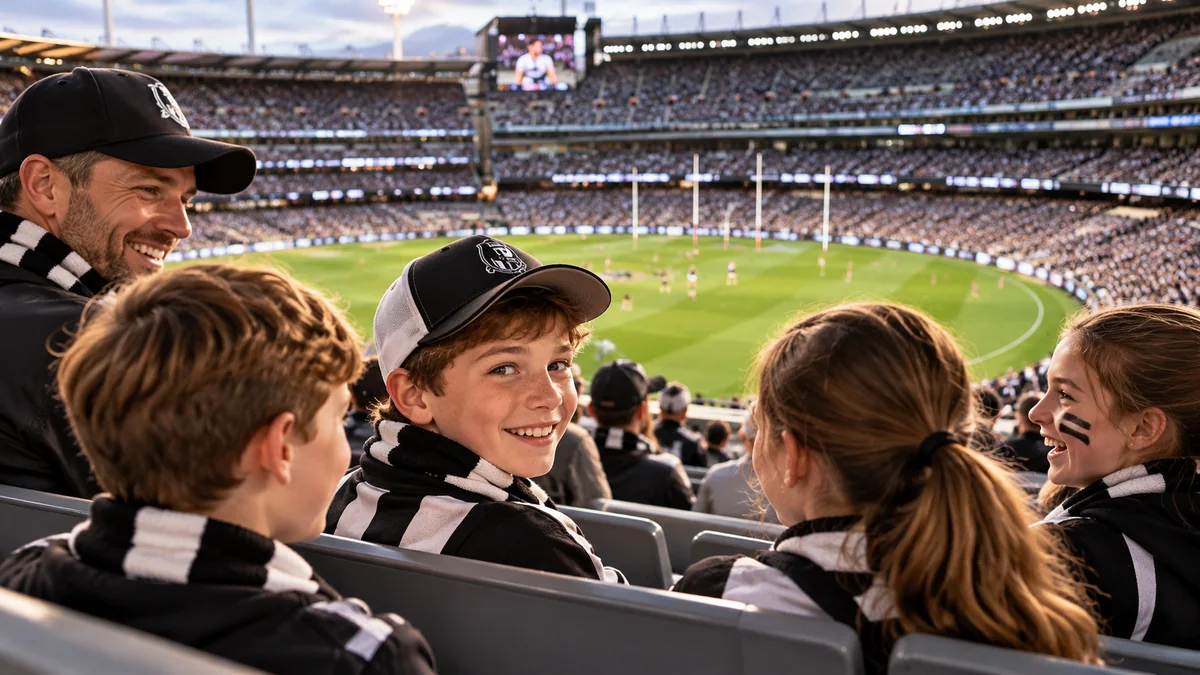
Imagine sending a child to a Collingwood football match at the MCG.
They're attending alone, surrounded by thousands of unfamiliar people. The atmosphere is loud, emotions are running high, and some spectators may behave aggressively.
For a child who struggles with unfamiliar social situations, this could be overwhelming.
Now imagine a different experience.
A trusted adult accompanies the child, helps them navigate the stadium and takes them to a designated family-friendly seating area.
The child sits alongside a small group of other children who share their interest in football.
The adult helps them feel included, explains unfamiliar situations and provides support when needed.
It's the same football match, but a very different social experience.
Online gaming can be approached in a similar way.
Can Structure and Supervision Make Gaming More Supportive?
An unrestricted public gaming lobby and a small, facilitated gaming group are not equivalent environments.
In a public lobby, children may encounter unfamiliar players, unpredictable interactions and limited adult supervision.
In a structured group, participation can be organised around age-appropriate activities, familiar peers, clear expectations and adult guidance.
A facilitator can encourage quieter participants, support cooperation, help resolve disagreements and recognise positive interactions.
These measures cannot eliminate every risk, but they can create opportunities for more predictable and supportive social experiences.
What Does the Research Tell Us?
Research suggests that online gaming can provide meaningful opportunities for social connection.
A 2025 report from Australia's eSafety Commissioner found that 63% of surveyed young gamers with disability felt gaming helped them connect socially.
However, the report also identified risks associated with online gaming, reinforcing the importance of appropriate safeguards.
Research supported by the US National Institutes of Health has also identified associations between gaming and certain cognitive skills, although these findings do not establish that gaming causes improvements.
The evidence supports considering both the potential opportunities and the risks, rather than treating every gaming environment as equivalent.
How Does FriendWorX Approach This?
FriendWorX applies the principle of supported participation to online gaming.
Children join small, age-matched groups of up to four participants, supported by an adult Guide.
Rather than entering unrestricted public gaming environments, participants engage in scheduled cooperative activities designed to encourage communication, teamwork and inclusion.
Guides support group interactions, while individual goals and milestones help recognise participation and progress.
The objective is not to increase children's gaming time. It is to create structured opportunities for social connection through activities they already enjoy.
What Should Parents and Professionals Consider?
When evaluating an online gaming opportunity, it may be useful to ask:
- Who will the child be interacting with?
- Is an appropriate adult present to provide guidance?
- Are the activities cooperative and age-appropriate?
- Are there clear boundaries and safeguarding arrangements?
- Does the environment support the child's individual needs?
Just as attending a football match with appropriate support can be different from attending alone, the experience of online gaming can vary considerably depending on how participation is organised.
The question isn't simply whether online gaming is good or bad. It's whether we're creating the right environment for children to participate safely and meaningfully.
Sources and Further Reading
- It's More Than Fun and Games: The Online Gaming Experiences of Children and Young People With Disability (Australian eSafety Commissioner, 2025)
- Video Gaming May Be Associated With Better Cognitive Performance in Children (National Institutes of Health, 2022, updated 2023)
- Game On: Unravelling the Bright and Dark Sides of Online Gaming (Monash University, 2021)
- Online gaming safety information (Australian eSafety Commissioner)