
Gaming, Screen Time & Child Development
Is Gaming Good or Bad for Children's Mental Health?
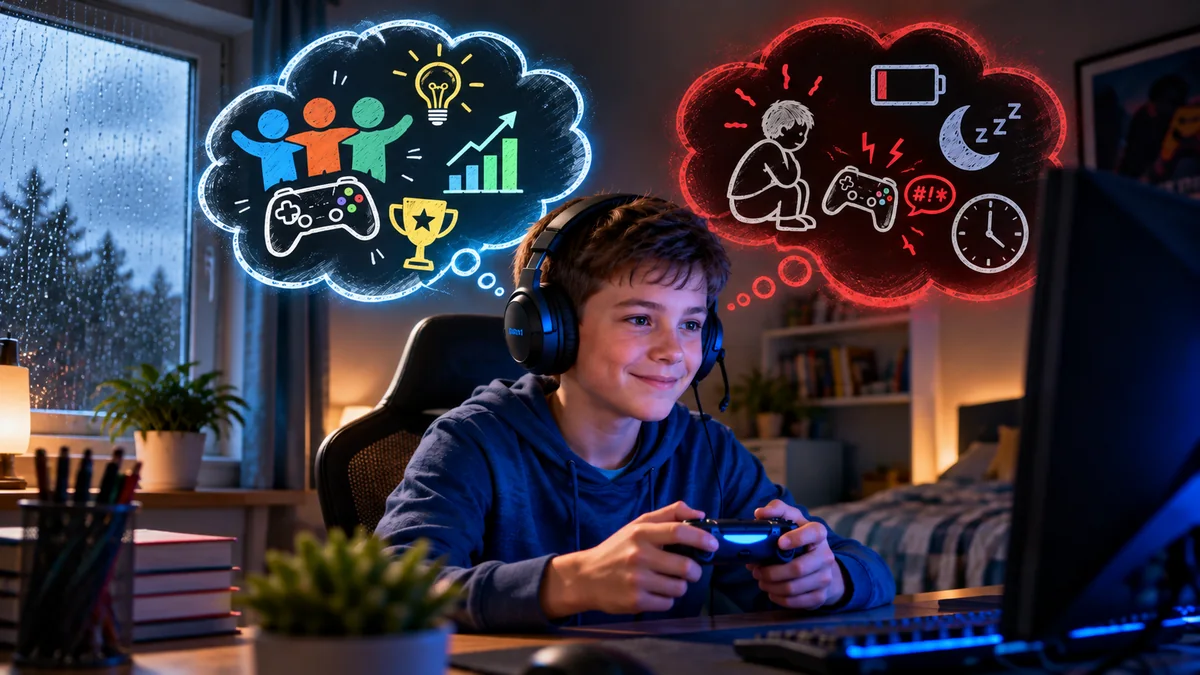
Video gaming can have both positive and negative effects on children's wellbeing. Gaming can provide enjoyment, friendship, relaxation and opportunities to develop cognitive skills. However, excessive gaming, negative online interactions and disrupted routines can create problems. What matters is not simply how long children play, but what they play, who they play with and how gaming fits into their lives.
Published Updated
What Are the Benefits?
Video games offer more than entertainment. They can encourage problem-solving, cooperation, communication and a sense of achievement.
Multiplayer games provide opportunities to connect with others through shared interests. For children who find face-to-face social situations challenging, gaming may offer a more comfortable environment for participating and building friendships.
Research also suggests that gaming may be associated with stronger performance in certain cognitive skills, including working memory and impulse control.
What Should Parents Consider?
Gaming can become concerning when it regularly interferes with sleep, school, physical activity, relationships or other important aspects of daily life.
Online gaming may also expose children to bullying, exclusion, inappropriate language and unwanted contact.
Competitive environments can create frustration, while some game reward systems encourage extended play.
Parents should consider how gaming affects their child's mood, behaviour and daily routines rather than focusing exclusively on screen time.
What Does the Research Say?
A 2022 study supported by the US National Institutes of Health examined nearly 2,000 children aged 9–10.
Children who reported playing video games for three or more hours daily performed better on tests of working memory and impulse control than children who reported not gaming.
However, frequent gamers also reported higher levels of some attention and mental health symptoms, although average scores remained below clinical thresholds.
Importantly, the study was observational. It could not establish whether gaming caused these differences.
The World Health Organization also recognises gaming disorder, which involves persistent difficulties controlling gaming that significantly interfere with everyday life. This does not mean that enthusiastic gaming automatically indicates a disorder.
How Does FriendWorX Approach This?
FriendWorX focuses on structured social participation rather than unrestricted gaming.
Children participate in small, age-matched groups of up to four young people, supported by an adult Guide.
Cooperative activities encourage communication, teamwork and shared achievements. Individual goals and milestones provide opportunities to recognise social participation and progress.
Sessions are scheduled and limited to 90 minutes, providing clear boundaries around FriendWorX activities.
Parents remain responsible for managing gaming time outside these sessions.
What Can Parents Do?
Talk with your child about the games they enjoy, who they play with and how gaming makes them feel.
Encourage a healthy balance between gaming, sleep, physical activity, school and other interests.
Consider the gaming environment as well as the game itself. Playing with familiar peers in a supportive setting can be very different from participating in an unrestricted public lobby.
Sources and Further Reading
- Video Gaming May Be Associated With Better Cognitive Performance in Children (National Institutes of Health, 2022, updated 2023)
- Game On: Unravelling the Bright and Dark Sides of Online Gaming (Monash University, 2021)
- Mind Games (Australian Psychological Society, 2018)
- Gaming Disorder (World Health Organization)